Not sure how to begin?
We clarify the topic, requirements, structure and the first practical steps.
Personalised academic and research support for undergraduate and postgraduate students, doctoral researchers, professionals and organisations — in Greek and English.
Evi Rosolimou
Personal collaboration, research-driven support and continuity from the first conversation through to the completion of each project.
Every academic project has different requirements. We start from where you are now and organise the next steps with clarity.
We clarify the topic, requirements, structure and the first practical steps.
We organise the search strategy, sources, keywords, referencing and evidence base.
We work through the research design, tools and the logic of the analysis.
SPSS, tables, statistical analysis and clear presentation of findings.
We organise the comments and turn them into a focused revision plan.
We maintain continuity from research planning through to final academic editing.
For undergraduate, postgraduate and doctoral needs, as well as research projects requiring methodology, analysis or evidence-based development.
You know what needs to be done now and what follows next.
Your project gains a clear structure, timeline and coherent research pathway.
Support is grounded in appropriate literature, methodology and academic requirements.
A clean visual journey through our core academic and research support services.

Choose a service from the horizontal bar. On mobile, swipe horizontally to explore all options.
Student assignments and coursework are developed in response to the specific assignment brief, subject area, course instructions and academic requirements of the relevant programme. They therefore do not follow a single standard format. Depending on the task, an assignment may require theoretical discussion, a literature review, critical engagement with existing knowledge, case-study analysis or the application of a particular research approach. Clearly understanding the academic or research problem and identifying appropriate sources are fundamental to developing well-supported academic work (Booth et al., 2024; Creswell & Creswell, 2023).
Support may include organising the overall structure and individual sections, identifying and evaluating relevant academic literature, developing and supporting key arguments, and integrating sources appropriately into the text. Particular attention is given to connecting arguments with supporting evidence so that the assignment moves beyond a simple presentation of information and develops a coherent academic argument (Booth et al., 2024). Support may also include academic editing, referencing, preparation of the reference list and final formatting in accordance with university guidelines.
The aim is for the final work to demonstrate clear structure, coherence, appropriate academic evidence and a focused response to the assignment brief.
Booth, W. C., Colomb, G. G., Williams, J. M., Bizup, J., & FitzGerald, W. T. (2024). The craft of research (5th ed.). University of Chicago Press.
Creswell, J. W., & Creswell, J. D. (2023). Research design: Qualitative, quantitative, and mixed methods approaches (6th ed.). SAGE Publications.
A dissertation is a complete research project in which the research problem, literature review, research questions and methodology need to be clearly and consistently connected. The appropriate research approach depends on the subject and research questions, while the overall design should maintain a logical progression from the initial formulation of the research problem through to the presentation and interpretation of the findings (Bell et al., 2024; Creswell & Creswell, 2023).
Support may include organising the dissertation structure and chapters, systematically identifying and using relevant academic literature, developing the theoretical framework, formulating research questions or hypotheses and designing an appropriate methodology. Depending on the nature of the project, support may also extend to organising data collection, analysing and presenting findings and connecting those findings with the existing literature. Developing well-supported arguments and critically evaluating sources are central elements of coherent research work (Booth et al., 2024).
Particular attention is given to coherence across the individual chapters, so that the literature review leads logically to the research questions, the methodology addresses those questions, and the findings and discussion return to the original research objectives.
Bell, J., Waters, S., & Johnson, H. (2024). Doing your research project: A guide for first-time researchers (8th ed.). Open University Press/McGraw Hill.
Booth, W. C., Colomb, G. G., Williams, J. M., Bizup, J., & FitzGerald, W. T. (2024). The craft of research (5th ed.). University of Chicago Press.
Creswell, J. W., & Creswell, J. D. (2023). Research design: Qualitative, quantitative, and mixed methods approaches (6th ed.). SAGE Publications.
A master’s research project requires a clearly defined research problem, its appropriate positioning within the existing academic literature, and a methodological approach that genuinely addresses the research questions. Coherence between the research aim, research questions, theoretical framework and methods of data collection and analysis is a fundamental element of sound research design (Bell et al., 2024; Creswell & Creswell, 2023).
Support may begin with defining the scope of the topic and research aim and extend to the literature review, development of the theoretical or conceptual framework, formulation of research questions or hypotheses, and selection of a qualitative, quantitative or mixed-methods approach. Methodological choice should follow from the nature of the research problem and the type of evidence required to answer the research questions (Creswell & Creswell, 2023).
Depending on the research design, support may also include developing or organising research instruments, quantitative data analysis using SPSS, qualitative analysis of interviews or other research material, presentation of findings and development of the discussion (Bell et al., 2024).
Bell, J., Waters, S., & Johnson, H. (2024). Doing your research project: A guide for first-time researchers (8th ed.). Open University Press/McGraw Hill.
Creswell, J. W., & Creswell, J. D. (2023). Research design: Qualitative, quantitative, and mixed methods approaches (6th ed.). SAGE Publications.
Doctoral research requires a clearly defined research problem, critical positioning of the study within existing academic knowledge and a well-supported account of the contribution the research aims to make. The research design needs to establish a consistent relationship between the theoretical or conceptual framework, research questions, methodological approach and procedures for data collection and analysis (Creswell & Creswell, 2023; Phillips & Pugh, 2015).
Support may address different stages of the research journey, from developing or revising the research proposal and clarifying the research gap to systematically organising the literature, developing the theoretical framework and designing the methodology. Where a project involves an extensive evidence synthesis, systematic procedures for searching, selecting and reporting the literature may be applied, including PRISMA 2020 guidance where appropriate (Page et al., 2021).
At later stages, research support may include organising and analysing quantitative or qualitative data, presenting and interpreting findings, connecting results with previous research and systematically revising individual chapters.
Creswell, J. W., & Creswell, J. D. (2023). Research design: Qualitative, quantitative, and mixed methods approaches (6th ed.). SAGE Publications.
Page, M. J., McKenzie, J. E., Bossuyt, P. M., Boutron, I., Hoffmann, T. C., Mulrow, C. D., Shamseer, L., Tetzlaff, J. M., Akl, E. A., Brennan, S. E., Chou, R., Glanville, J., Grimshaw, J. M., Hróbjartsson, A., Lalu, M. M., Li, T., Loder, E. W., Mayo-Wilson, E., McDonald, S., … Moher, D. (2021). The PRISMA 2020 statement: An updated guideline for reporting systematic reviews. BMJ, 372, n71. https://doi.org/10.1136/bmj.n71
Phillips, E. M., & Pugh, D. S. (2015). How to get a PhD: A handbook for students and their supervisors (6th ed.). Open University Press.
Statistical analysis is not limited to running a series of tests in SPSS. It begins with the research questions and the nature of the data and requires the selection of appropriate statistical procedures, assessment of relevant assumptions and accurate interpretation of the results. Decisions between descriptive and inferential statistics, as well as parametric and non-parametric techniques, should reflect the research design, variable types and characteristics of the data (Field, 2024; Pallant, 2020).
Support may include preparing and checking the dataset, coding variables, producing descriptive statistics, assessing scale reliability and examining the assumptions required for the selected analyses. Depending on the research questions, appropriate procedures may include correlations, t-tests, analysis of variance (ANOVA), non-parametric tests, regression and other suitable statistical techniques (Field, 2024).
Equally important is the accurate academic presentation and interpretation of statistical findings. Tables and statistical results need to be connected to the research questions and presented in a way that enables the reader to understand what the analysis demonstrates (Field, 2024).
Field, A. (2024). Discovering statistics using IBM SPSS Statistics (6th ed.). SAGE Publications.
Pallant, J. (2020). SPSS survival manual: A step by step guide to data analysis using IBM SPSS (7th ed.). Open University Press.
Research methodology provides the link between what a study aims to investigate and the way in which evidence will be collected and analysed. The choice between qualitative, quantitative and mixed-methods approaches should reflect the research problem, study aims, research questions and the type of knowledge the research seeks to generate (Creswell & Creswell, 2023).
Support may include developing or refining research questions and hypotheses, selecting an appropriate research design, defining the population and sample, choosing a sampling strategy and designing suitable data-collection instruments. Depending on the methodological approach, these may include questionnaires, semi-structured interviews, observation, case studies or a combination of different methods (Creswell & Creswell, 2023; Saunders et al., 2023).
The methodology should also explain why each procedure has been selected and how it contributes to answering the research questions. Data collection and analysis, validity or reliability, and ethical considerations are important components of a complete methodology section (Bell et al., 2024).
Bell, J., Waters, S., & Johnson, H. (2024). Doing your research project: A guide for first-time researchers (8th ed.). Open University Press/McGraw Hill.
Creswell, J. W., & Creswell, J. D. (2023). Research design: Qualitative, quantitative, and mixed methods approaches (6th ed.). SAGE Publications.
Saunders, M. N. K., Lewis, P., & Thornhill, A. (2023). Research methods for business students (9th ed.). Pearson.
A literature review is not simply a collection and sequential presentation of published studies. Its purpose is to organise, evaluate and critically synthesise existing knowledge on a defined research topic, identifying major theoretical perspectives, areas of agreement and disagreement across findings, and aspects of the literature where research gaps remain (Snyder, 2019).
Depending on the purpose of the research, a narrative, critical or systematic literature review (SLR) may be appropriate. In an SLR, the process should be explicit, systematic and reproducible, incorporating a predefined research question, search strategy, appropriate databases, inclusion and exclusion criteria and a documented study-selection process (Snyder, 2019; Tranfield et al., 2003).
Support may include developing the research question, identifying keywords and constructing search strings, selecting databases, defining inclusion/exclusion criteria, organising the screening process and structuring the selected studies for subsequent analysis and synthesis. Where PRISMA 2020 is applicable, the selection and reporting process is presented transparently, including the PRISMA flow diagram (Page et al., 2021).
The most important stage remains the synthesis of the literature. Studies should be organised around thematic or other analytical dimensions so that the review demonstrates what is already known, where contradictions and limitations occur and which research questions remain unresolved (Snyder, 2019).
Page, M. J., McKenzie, J. E., Bossuyt, P. M., Boutron, I., Hoffmann, T. C., Mulrow, C. D., Shamseer, L., Tetzlaff, J. M., Akl, E. A., Brennan, S. E., Chou, R., Glanville, J., Grimshaw, J. M., Hróbjartsson, A., Lalu, M. M., Li, T., Loder, E. W., Mayo-Wilson, E., McDonald, S., … Moher, D. (2021). The PRISMA 2020 statement: An updated guideline for reporting systematic reviews. BMJ, 372, n71. https://doi.org/10.1136/bmj.n71
Snyder, H. (2019). Literature review as a research methodology: An overview and guidelines. Journal of Business Research, 104, 333–339. https://doi.org/10.1016/j.jbusres.2019.07.039
Tranfield, D., Denyer, D., & Smart, P. (2003). Towards a methodology for developing evidence-informed management knowledge by means of systematic review. British Journal of Management, 14(3), 207–222. https://doi.org/10.1111/1467-8551.00375
An academic or research presentation is not simply a written paper transferred onto slides. It requires selecting and prioritising the most important information, developing a clear narrative structure and organising visual material appropriately so that the audience can follow the research problem, methodology, key findings and conclusions within the available time (Alley, 2013; Doumont, 2009).
Support may include undergraduate and master’s dissertation presentations, doctoral research presentations, research proposals, academic papers and conference presentations. This may involve identifying the material that should be presented, developing a logical progression between slides and transforming detailed written material into concise and accessible presentation content.
Particular attention is given to the balance between text, tables, charts and other visual elements. Visual material should support the central message rather than compete with the speaker for the audience’s attention. Clear visual hierarchy and a focused message on each slide can make complex research information easier to understand (Alley, 2013; Kosslyn, 2007).
Where required, support may also include developing speaker scripts or presentation notes, coordinating the slides with the spoken presentation, adapting the material to the available presentation time and organising content for academic or conference settings.
Alley, M. (2013). The craft of scientific presentations: Critical steps to succeed and critical errors to avoid (2nd ed.). Springer. https://doi.org/10.1007/978-1-4419-8279-7
Doumont, J.-L. (2009). Trees, maps, and theorems: Effective communication for rational minds. Principiae.
Kosslyn, S. M. (2007). Clear and to the point: 8 psychological principles for compelling PowerPoint presentations. Oxford University Press.
Selected universities and educational institutions attended by students and researchers I have supported across academic and research projects.
Institution names refer solely to prior experience supporting students/researchers enrolled in those institutions and do not imply official affiliation, representation, endorsement or partnership.
Support is tailored to the subject area, institutional specifications and the stage of each project.
Research problem, aims, questions, hypotheses, literature grounding and conceptual framework.
Read the Research Proposal guide →Search strategy, databases, inclusion/exclusion criteria, screening and evidence synthesis.
Read the SLR & PRISMA guide →Quantitative and qualitative designs, case studies, questionnaires, interviews and thematic analysis.
Read the Research Methodology guide →Data organisation, statistical analysis, tables, figures and interpretation of findings.
Read the SPSS & Data Analysis guide →Structure, coherence, academic style, referencing, formatting and institution-specific requirements.
Read the Academic Writing & Discussion guide →APA, Harvard, OSCOLA and professional academic or research presentations.
Read the APA 7 & Referencing guide →Research support throughout your PhD.
Learn more →Support for postgraduate research and its requirements.
Learn more →Explore support for your final thesis.
Learn more →Doctoral research is treated as a distinct area of support, with emphasis on methodological consistency, evidence synthesis, conceptual development and rigorous academic presentation.
Indicative experience spans Management and Organisational Behaviour, Public Sector performance evaluation, Health Services Management and community midwifery care, as well as Education and Generative AI.
Extensive experience with Special Education and Education projects, including literature-based and empirical postgraduate studies as well as practice-oriented academic deliverables.
Areas include special educational needs, learning difficulties, Autism Spectrum Disorder (ASD), intellectual disability, inclusive education, differentiated instruction, Universal Design for Learning (UDL), teacher attitudes and educational assessment.
All semesters – 2026/2027
Professional research support for the development, organisation and preparation of clients' scientific articles, without presenting those papers as the consultant's own publications.
Support is tailored to the research field, article type and target journal, and may include systematic-review methods, research design or data analysis where relevant.
Presentation design that combines research accuracy, clear structure and strong visual communication. Support may cover Master's and PhD presentations, research proposals, defense/viva decks, scientific or conference presentations, and executive/business presentations.
More than attractive slides: the aim is to transform complex material into a clear, coherent and professional visual narrative.
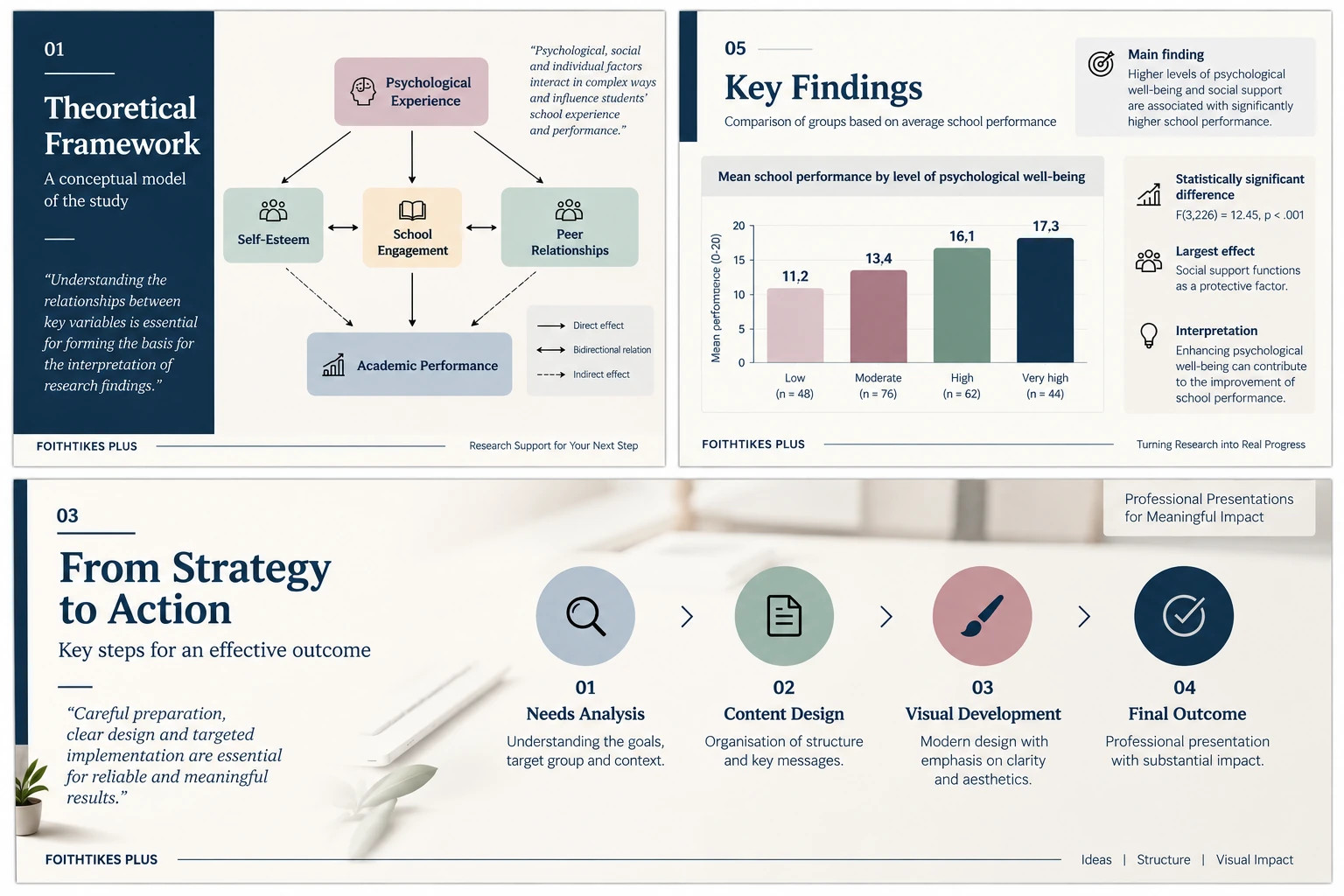
Original FOITHTIKES PLUS demonstration layouts. All content and data are fictional and do not originate from client work.
Effective translation and professional writing involve more than transferring words between languages. They require accuracy of meaning, appropriate terminology, audience-sensitive language and consistency with the purpose of each document.
Greek → English and English → Greek support with particular attention to discipline-specific terminology and appropriate academic register.
Professional document development and restructuring designed to communicate experience, skills, achievements and career direction clearly.
Evidence-informed articles on important stages of academic and research projects.
From the research problem and objectives to research questions, literature grounding, methodology, ethics and expected contribution.
Read more →Search strategy, databases, keywords, inclusion/exclusion criteria, screening, PRISMA flow and evidence synthesis.
Read more →From research design and data cleaning to statistical-test selection, effect sizes and interpretation.
Read the guide →From interviews and coding to theme development, reflexivity and evidence-based presentation of findings.
Read the guide →Research problem, literature review, methodology, analysis, discussion and common structural mistakes.
Read the guide →Research gap, SLR/PRISMA, conceptual framework, methodology, analysis and scholarly contribution.
Read the guide →Research design, sampling, instruments, ethics and data analysis in a coherent methodology chapter.
Read the article →Turn a research problem into focused questions and, where appropriate, testable hypotheses.
Read the article →Understand the differences and select the approach that best fits your research question.
Read the article →Design an interview guide, use effective prompts and prepare qualitative data for analysis.
Read the article →Descriptive statistics, tests, p-values, effect sizes, tables and clear reporting.
Read the article →Practical guidance on citations, references, DOIs, multiple authors and common errors.
Read the article →Search, thematic organisation, critical synthesis, research gaps and connection to your study.
Read the article →Choose a topic that is focused, feasible, researchable and supported by accessible evidence.
Read the article →Connect findings with research questions, literature, theory, limitations and implications.
Read the article →Understand similarity reports, source matches and academically appropriate use of evidence.
Read the article →Experience spans a broad range of academic and research disciplines. The areas below are highlighted because of particularly extensive work across different project levels, without limiting the wider scope of services.
Experience developed across projects at different academic levels and programmes in Greece, Cyprus and internationally.
Strategy, Leadership, HRM, Organisational Behaviour, Change Management, Project & Stakeholder Management, Entrepreneurship, Innovation, Corporate Governance, Risk and Business Planning.
Brand Management, Consumer Behaviour, Digital Marketing, CRM, Customer Experience, communication, market and competitive research.
Work, School and Forensic Psychology, mental health, personality, psychometrics, child and family topics, behavioural and cognitive themes.
Educational leadership, educational technology, intercultural education, inclusion, UDL, ASD, learning difficulties, assessment, interventions and instructional design.
Nursing, Midwifery, Public Health, evidence-based care, nutrition and metabolism, exercise & health, occupational therapy and health services management.
International & European Law, Public International Law, International Humanitarian Law, Criminal/Common Law, Criminology, cyber warfare/security, Maritime Law and European Studies.
Shipping, ports, supply chain & logistics, maritime risk and safety, green ports, sustainable shipping, environmental policy and port competitiveness.
Tourism and hospitality management, hotel HRM, leadership, tourism product and sustainable tourism development.
Literature, philological analysis, sociology, social policy, criminology and juvenile delinquency.
International Finance, management accounting, performance measurement, costing and business performance.
Public sector management, public policy, governance, organisational evaluation and administrative research.
Theological and religious topics, literature research, theoretical development and academic evidence.
Research design, quantitative and qualitative methods, SPSS, thematic analysis, SLR, PRISMA and research instruments.
Support is not limited to the fields listed above. Interdisciplinary projects and specialised requirements are considered according to subject area, academic level and project specifications.
What sets our approach apart is not promises, but the way each project is structured, managed and supported throughout the process.
Research & Academic Consultant with 15+ years of professional experience and an interdisciplinary academic background in European Studies, Marketing and International & Maritime Law.
Professional experience combines academic research support, research development and editing, evidence gathering, and market/competitive data analysis across a wide range of disciplines.
Personal communication at every stage. From the first conversation through to the completion of our collaboration, communication remains direct, personal and meaningful, with continuity and attention to the needs of the project.
My academic journey also includes two years of Law studies at the University of Wales, an experience that further strengthened my interdisciplinary background and preceded my later specialisation in International & Maritime Law.
An approach combining evidence-based practice, personal collaboration and respect for the specific demands of each research project.
For academic and research support to be a meaningful collaborative process that develops an initial idea into a clear, well-supported and academically coherent research project.
To provide personalised academic and research guidance by combining methodological rigour, evidence-based support and direct collaboration throughout the research process.
Research integrity • Confidentiality • Personal collaboration • Clear communication • Respect for academic ethics.
Two short Reels featuring real people and study moments, bringing a more human and dynamic feel to the academic journey.
Real messages from past collaborations, with names and personal details anonymised.
* Testimonials have been anonymised to protect personal data.
Pricing is tailored after an initial assessment of the subject, research stage, methodology, timeline and institutional requirements.
Send the topic/title, university or programme, deadline, official guidelines and any material already completed. The scope, deliverables, timeline and fee can then be defined clearly.
Request a quote →Services are provided as research guidance, methodological support, analysis, academic editing and educational assistance. Final use and submission remain the responsibility of the student or researcher and must comply with the academic integrity rules of the relevant institution.
Personal collaboration, research-driven support and continuity from the first conversation through to the completion of each project.
Direct, personal communication from start to finish, with continuity and attention at every stage.
Methodology, SLR & PRISMA, SPSS, statistical and qualitative analysis, with a strong focus on research evidence.
Every collaboration is handled with discretion, clear communication and respect for academic and professional requirements.
Support is tailored to the subject area, programme requirements and the genuine needs of each research project.
For an initial assessment, send the topic, institution/programme, deadline, guidelines and any material already completed.